

In this review about how we can create 3d printed drones as this technology could be used to create civilian drones, including some concrete examples. On the contrary, we see news everywhere about Ukraine destroying Russian tanks using 3d printed drones manufactured under $300. That’s a big debatable topic but here we would aim to provide you with the best analysis possible and to some extent let you know how to 3d print drones as this particular niche has opened up new possibilities for customization, rapid prototyping, and cost-effective manufacturing. This innovative approach to drone production is transforming the industry in several ways. Well to know in detail how to 3d print functional drones read this guide while we ponder over the benefits of making our own drones below:
#1 Customization at Your Fingertips
One of the most significant advantages of 3D printing in drone manufacturing is the ability to create custom parts quickly and easily. Drone enthusiasts and professionals alike could design and print specialized components that perfectly fit their needs. For instance, a wildlife photographer might print a unique camera mount that allows for better stability during flight, while a survey company could create a custom housing for specialized sensors so for customization sky is the limit and the opportunities are just boundless.
#2 Rapid Prototyping Speeds Up Innovation
The drone industry moves at a lightning pace, and 3D printing helps keep up with this rapid evolution. Manufacturers can now design, print, and test new drone parts in a matter of days, rather than weeks or months. This quick turnaround time allows for faster iteration and improvement of designs. A real-world example of this is the development of the Zipline delivery drone. The company used 3D printing to rapidly prototype and test different wing designs, ultimately creating a highly efficient fixed-wing drone capable of delivering medical supplies to remote areas.
#3 Cost-Effective Small-Scale Production
For small businesses and startups, 3D printing offers an affordable way to enter the drone market like honestly, instead of investing in expensive molds and traditional manufacturing processes, these companies can use 3D printers to produce small batches of drones or replacement parts. For example the DJI, the world’s largest consumer drone manufacturer, has embraced 3D printing for producing jigs and fixtures used in their assembly lines. This approach has significantly reduced their production costs and improved efficiency.
#4 Lightweight Yet Strong Structures
3D printing allows for the creation of complex, lightweight structures that would be difficult or impossible to produce using traditional manufacturing methods. This is particularly important in drone design, where every gram of weight matters. The Volocopter, an electric air taxi prototype, uses 3D-printed components in its structure. These parts are designed with intricate internal geometries that maximize strength while minimizing weight, resulting in improved flight performance and energy efficiency.
#5 Repair/Upgrading Made Easy
When a drone part breaks or needs upgrading, 3D printing offers a quick and easy solution. Owners can simply download the necessary 3D model and print the replacement part at home or at a local 3D printing service. This reduces downtime and extends the lifespan of drones.
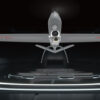
Like, honestly speaking, we all know how AI is exponentially getting into everything, while 3D printing technology coupled with AI would continues to advance, we could see even more impressive applications in the drone industry. Researchers are already experimenting with printing entire drone frames using advanced materials like carbon fiber-reinforced plastics, which could lead to stronger, lighter, and more capable drones in the future. 3D printing is not just changing how we make drones; it’s revolutionizing what drones can do. From customized designs for specific applications to rapid prototyping that accelerates innovation, this technology is pushing the boundaries of what’s possible in civilian drone manufacturing. As 3D printing becomes more accessible and sophisticated, we can expect to see even more exciting developments in the world of drones.
Printing your own frames and mounts is where a lot of builders end up, and it brings a problem the shop bought crowd never has. Nylon, PETG and carbon fibre blends all print differently, and none of it is labelled once a spool is half gone.
PrintVault is an Android app that tracks spools by weight and costs out each print, storing the nozzle and bed range against every roll. Worth having if you print frames often enough for the filament bill to register.