

Recent years have seen significant progress in making AI for drones more energy-efficient, addressing the critical challenge of limited battery life and onboard computational resources. There are great many changes that we notice in new drones 2025 which are mostly powered by AI which is used in drones. Here are the key advancements:
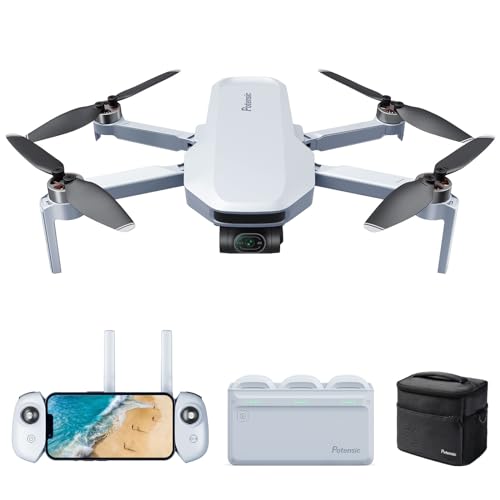
- 【𝐋𝐢𝐠𝐡𝐭𝐰𝐞𝐢𝐠𝐡𝐭, 𝐥𝐞𝐬𝐬 𝐭𝐡𝐚𝐧 𝟐𝟒𝟗𝐠】 The...
- 【𝐑𝐨𝐜𝐤 𝐒𝐭𝐞𝐚𝐝𝐲 𝟒𝐊 𝟑-𝐀𝐱𝐢𝐬 𝐆𝐢𝐦𝐛𝐚𝐥】Equipped...
- 【𝟏.𝟑𝐇 𝐅𝐚𝐬𝐭 𝐂𝐡𝐚𝐫𝐠𝐞, 𝟗𝟔 𝐌𝐢𝐧𝐬 𝐋𝐨𝐧𝐠...
Neuromorphic Computing and Brain-Inspired AI
There have been new chips developed for drone technology. The researchers are developing chips that mimic the neural architecture of the human brain, known as neuromorphic computing. These chips use artificial neurons and synapses, enabling drones to process information and make decisions with dramatically lower power consumption compared to traditional digital processors. For example, new flexible, neuron-like nano-devices and conducting polymer thin films are being designed for small drones, promising AI capabilities such as self-navigation and object recognition without drastically reducing flight time.
Unlike conventional AI models, spiking neural networks process information only when needed, further reducing energy use. These networks allow drones to make rapid, local decisions and integrate multiple sensor inputs efficiently, extending operational time.
Lightweight AI Processors and Edge Computing
These are specialized, lightweight AI chips are being integrated into drones, allowing complex computations to be performed onboard rather than relying on power-hungry cloud processing. This not only saves energy by reducing data transmission but also enables real-time decision-making for tasks like obstacle avoidance and navigation. So, by processing data directly on the drone, edge computing reduces latency, improves autonomy, and minimizes energy spent on wireless communication. This is particularly beneficial for real-time applications such as search and rescue or surveillance, where immediate analysis is critical.
Efficient AI Algorithms and Model Optimization
There have been various techniques such as pruning (removing unnecessary neural network connections) and quantization (using lower-precision calculations) are being used to shrink AI models, making them less resource-intensive and more suitable for drone hardware. The new AI algorithms are being designed specifically to optimize flight paths, avoid obstacles, and minimize energy consumption by learning from real-world data and adapting in real time.
Battery and Energy Harvesting Innovations
The research across the globe continues into batteries with higher energy density and faster charging, complementing AI advancements to extend drone flight times. Some efforts focus on enabling drones to recharge during flight using solar panels or other energy-harvesting techniques, further supporting long-duration autonomous missions.
Generative and Adaptive AI
Advanced AI models can generate optimal flight paths by considering environmental factors, regulatory restrictions, and energy constraints, significantly reducing unnecessary energy expenditure. Drones equipped with adaptive AI can learn from past missions, refining their behavior to become more energy-efficient over time.
Energy-efficient AI for drones is advancing rapidly through innovations in neuromorphic hardware, lightweight processors, edge computing, optimized algorithms, and adaptive learning. These technologies collectively enable drones to perform complex, autonomous tasks while maximizing flight duration and minimizing energy consumption-a critical step toward practical, intelligent, and sustainable drone operations.
Explore the transformative benefits of AI-driven navigation that allows drones to learn, adapt, and operate with unprecedented intelligence.
Self-learning navigation represents a pivotal shift in drone technology, moving beyond pre-programmed routes and direct human control. By leveraging advanced Artificial Intelligence (AI), particularly machine learning (ML) techniques like deep learning and reinforcement learning (RL), drones can now perceive their surroundings, learn from experience, and make independent decisions in real-time. This guide delves into the significant advantages this intelligent navigation offers, enhancing drone capabilities across various domains.
Key Highlights of Self-Learning Navigation
Self-learning algorithms enable superior real-time obstacle detection and avoidance, significantly reducing collision risks, especially in dynamic or unknown environments. While the drones can operate independently in complex, GPS-denied areas, optimize flight paths for time and energy, and manage tasks with minimal human intervention. These intelligent drones can dynamically adjust to unforeseen circumstances, changing weather conditions, and diverse terrains without needing reprogramming.
Elevating Safety and Reducing Risk
One of the most significant benefits of self-learning navigation is the dramatic improvement in drone safety. Traditional navigation methods often struggle in unpredictable settings. Self-learning systems, powered by AI, continuously analyze data from sensors like cameras, LiDAR, and IMUs to build a dynamic understanding of the environment. This allows drones to:
While using techniques like deep reinforcement learning, drones learn sophisticated policies to identify and navigate around both static objects (buildings, trees) and dynamic obstacles (birds, other vehicles, people) with remarkable speed and precision. Research shows drones achieving speeds up to 70 km/h in cluttered environments while maintaining safety.
When GPS signals are weak, jammed, or unavailable (indoors, underground, urban canyons, contested areas), self-learning drones utilize computer vision and sensor fusion for localization and navigation (SLAM – Simultaneous Localization and Mapping). This ensures continued safe operation where traditional drones might fail or become unreliable. By enabling fully autonomous operation, these drones can undertake missions in hazardous environments – such as disaster zones, industrial inspection sites with toxic materials, or military reconnaissance areas – without risking human pilots.
AI improves standard safety features like Return-to-Home (RTH) by dynamically calculating the safest and most efficient route back, considering any new obstacles or environmental changes encountered during the mission.
- Self-learning enables drones to navigate complex paths and avoid obstacles autonomously.
- Boosting Efficiency and Operational Autonomy
Optimized Performance with Minimal Intervention
Self-learning navigation transforms drones into highly efficient autonomous agents capable of executing complex tasks with minimal human oversight. This translates into significant gains in productivity and resource optimization.
Intelligent Path Planning
Instead of rigidly following pre-set waypoints, self-learning drones dynamically optimize their flight paths. Using RL, they learn routes that minimize flight time and energy consumption based on real-time environmental data (like wind conditions) and mission objectives. This continuous optimization leads to longer flight durations and faster mission completion.
Autonomous Data Management
Drones equipped with self-learning capabilities can autonomously manage data collection for tasks like infrastructure inspection, agricultural monitoring, or surveillance. They can perform repetitive missions at specific intervals, ensuring data consistency and timeliness without requiring constant human setup and monitoring. Some models automate the entire workflow, from takeoff and data acquisition to landing and data uploading.
Reduced Reliance on Human Operators
The high degree of autonomy achieved through self-learning reduces the need for skilled human pilots, especially for large-scale or continuous operations. This allows organizations to deploy drone fleets more effectively, lowering operational costs associated with personnel training and management. A defining characteristic of self-learning drones is their exceptional adaptability. They are not limited by pre-existing maps or predictable conditions, enabling operation across a wide spectrum of environments.
The self-learning algorithms empower drones to explore and map unfamiliar areas on the fly, whether dense forests, complex urban landscapes, or indoor spaces, using sensor data to build environmental models. These drones can instantly react to sudden changes like unexpected obstacles, adverse weather shifts (e.g., wind gusts), or evolving mission parameters without human intervention or reprogramming. Training models in diverse simulated and real-world environments helps generalize their adaptive capabilities. As mentioned under safety, the ability to navigate accurately using onboard sensors (visual odometry, sensor fusion) makes them invaluable in environments where GPS is unreliable or completely absent.
Deep reinforcement learning enables drones to master complex, high-speed navigation tasks like drone racing.
Performance Comparison: Self-Learning vs. Traditional Navigation
#1 Visualizing the Advantages
This chart provides a comparative overview of key performance aspects between drones utilizing self-learning navigation and those relying on traditional (GPS-based, pre-programmed) methods. The scores represent a qualitative assessment of capabilities, highlighting the significant enhancements offered by AI-driven autonomy.
As illustrated, self-learning systems significantly outperform traditional methods, particularly in adaptability, autonomy, safety in complex situations, and operation without GPS reliance. While traditional drones may be efficient for simple, pre-defined tasks in open areas, self-learning unlocks capabilities essential for complex, real-world applications.