

The K600 GPS Drone with Camera Adult is presented as an accessible entry-level drone equipped with features such as a 1080P camera, GPS capabilities, and a modular battery system. This report aims to provide a comprehensive analysis of the drone’s technical specifications and operational capabilities based on publicly available online information. The analysis will address specific questions regarding the drone’s features, including the remote controller screen, storage, positioning system, battery performance, weight, camera capabilities, and operational range, as well as the regulatory implications of its use the place where you are going to use. This report is based on the examination of product listings, user reviews, and relevant regulatory information found online.
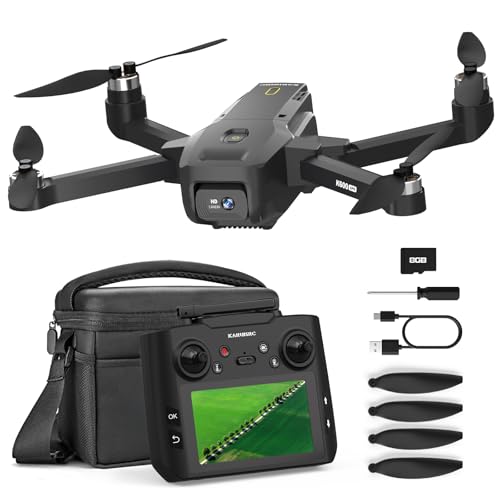
- Remote control screen: The drone remote control is equipped with a 4.5 inch high-definition screen, and the drone's...
- SD Card: The GPS drone remote controller supports taking photos or recording videos directly, all the image data...
- 1080P HD Camera: The GPS drone is equipped with a HD camera, which is detailed and colourful, whether it is a...
I. Product Overview and Key Advertised Features
(i) Retailer Listings and Availability
The K600 GPS Drone with Camera Adult, identified under the brand name “karuisrc” and model “K600,” is predominantly available through major online retailers. Listings can be found on platforms such as Amazon, Walmart, eBay, and Ubuy. The consistent branding and model name across these diverse platforms suggest that this product is likely manufactured by a single entity and distributed through various retail channels. The absence of an official, dedicated product website for the K600 drone is notable. This distribution model is common for mass-produced consumer electronics, where manufacturers or resellers prioritize broad market reach through established e-commerce infrastructures. This approach often emphasizes cost-effectiveness, potentially at the expense of direct brand building and customer engagement. Consequently, consumers might find varying levels of detailed information and customer support depending on the retailer they choose.
(ii) Key Features
The K600 drone is marketed with a range of features designed to appeal to adult beginners. A primary selling point is its dual camera system, which includes a front-facing camera capable of capturing 1080P high-definition video and still images, complemented by a 90° motorized adjustable lens. Additionally, a bottom-mounted camera provides alternative aerial perspectives. The drone utilizes brushless motors, which are generally more efficient, quieter, and have a longer lifespan compared to traditional brushed motors, contributing to a smoother flight experience. For flight stability, the K600 employs an optical flow positioning system. This technology uses the drone’s camera to analyze ground movement, enabling precise hovering and stable flight, particularly at lower altitudes or indoors. Powering the drone is an 1800mAh modular battery, designed to provide extended flight times and allow for easy swapping to prolong usage.
The drone offers a First Person View (FPV) experience by connecting to a smartphone via a 2.4GHz WiFi network, allowing the pilot to see what the drone’s camera sees in real-time through a dedicated mobile application. To enhance user-friendliness, especially for beginners, the K600 includes several intelligent flight modes such as auto hover, one-key takeoff and landing, headless mode, fixed-point flight, VR mode compatibility, and gesture control for capturing photos and videos. For portability and protection during transportation, the drone is often bundled with a carrying case.
Importantly, the drone’s weight is reported to be under 250 grams, specifically 184 grams. This weight is significant due to regulatory implications in many regions. The emphasis on beginner-friendly features, portability, and the inclusion of brushless motors at what appears to be a budget-friendly price point suggests that the K600 aims to provide an accessible entry into the world of drone piloting.
III. Detailed Technical Specification Analysis
A. Remote Controller and LCD Screen
The user query mentions a 4.5-inch LCD screen integrated into the remote controller of the K600 drone. However, a review of the available research material does not substantiate this claim. Product listings and descriptions on major retail sites like Amazon 1 and Walmart do not mention any integrated LCD screen on the remote. Instead, visual evidence from a YouTube review shows a remote controller equipped with a foldable mount designed to hold a smartphone.
This suggests that the primary display interface for the drone’s FPV system and potentially for accessing flight controls and telemetry data is likely the user’s own smartphone, running a dedicated application provided by the manufacturer. The absence of a dedicated LCD screen on the remote is a common characteristic of many entry-level drones, as it helps to reduce manufacturing costs and leverages the user’s existing smartphone technology for display purposes. This reliance on a smartphone app implies that the user will need a compatible smartphone to fully utilize the drone’s features, particularly the FPV functionality. Specifications such as resolution and refresh rate of the display would then be dependent on the user’s smartphone.
B. Storage and Media
The user query also inquires about a 32GB SD card purportedly included with the K600 drone. While several product listings, such as those on Amazon and Ubuy, indicate that the drone’s media type is SD card, none of the examined snippets explicitly confirm the inclusion of a 32GB SD card in the package. Furthermore, details regarding the read and write speeds or the specific compatibility requirements of the SD card with the drone are absent from the provided information. The mention of “Media Type: SD” simply suggests that the drone records its captured footage onto an SD card, which is a standard practice for drones in this category. The lack of clarity on whether an SD card is included and its specifications means that potential buyers should verify this information with the seller prior to purchase. If an SD card is not included or if its specifications are insufficient for the user’s needs (e.g., for recording high-definition video), they will need to purchase a compatible SD card separately. Typically, drones recording in 1080P HD require a Class 10 or higher microSD card to ensure smooth and uninterrupted recording.
C. Positioning and Autonomous Flight
The user query refers to a “Professional GPS” system in the K600 drone. However, the research material primarily highlights the drone’s use of “optical flow positioning” for achieving stable flight and hovering. The drone’s downward-facing camera to sense ground movement, allowing it to maintain its position accurately, especially in environments where a strong GPS signal might be unavailable, such as indoors or in areas with dense foliage.
This system often works in conjunction with an Inertial Measurement Unit (IMU) to provide more precise positional data, enabling the drone to hover and fly with stability comparable to that achieved by GPS in certain conditions. Despite the user’s query, none of the provided snippets offer specific details about a dedicated “Professional GPS” system, including its accuracy or the number of satellites it can connect to. While some product descriptions on platforms like Desertcart might mention GPS in the context of other drones, the focus for the K600 in the provided material remains on optical flow technology. Consequently, the reliability of autonomous features like “Auto Return” and “Follow Me” on the K600 cannot be definitively assessed based on the provided research. While these features are often associated with GPS-enabled drones, their implementation and effectiveness on a drone primarily relying on optical flow for positioning might differ. Optical flow is highly dependent on the visibility and texture of the ground surface; its performance can be affected by low-light conditions, reflective surfaces, or uniform textures.
D. Power and Battery Performance
The K600 drone is equipped with an 1800mAh modular battery. The modular design, as noted in snippets from Ubuy, allows for easy and quick battery replacement, which is a significant advantage for users who wish to extend their flight time by purchasing additional batteries. These modular batteries typically use lithium-ion technology, known for their high energy density relative to their weight, which is crucial for achieving longer flight durations in drones. However, the exact battery life and the charging time for the K600 drone depends on its usage the way someone uses it.
E. Weight and Regulatory Compliance
The weight of the K600 drone is 184 grams. This weight is notably below the 250-gram threshold that often triggers more stringent drone regulations in various countries. Regarding the specific drone regulations, the information gathered presents a somewhat complex picture.
F. Camera System
The K600 drone is advertised as having a dual camera setup featuring a front-facing 1080P HD camera with a 90° motorized adjustable lens and a secondary camera located on the bottom of the drone. The 1080P resolution indicates that the primary camera can capture videos and photos with a resolution of 1920×1080 pixels, which is considered high definition and suitable for general aerial photography and videography.
The 90° motorized adjustable lens is a significant feature, allowing the user to remotely control the camera’s tilt angle via the remote controller, thus providing greater flexibility in framing shots during flight. The inclusion of a bottom camera offers additional versatility for capturing different perspectives, such as directly downward views, which can be useful for surveying or unique aerial shots.
The drone’s software, accessible through the smartphone app, enables seamless switching between the two cameras. Furthermore, the drone supports gesture photography, allowing users to trigger the capture of photos and videos by performing specific hand gestures in front of the camera. Despite these details, the provided research material does not specify the sensor size or the lens quality of either of the cameras. These specifications are crucial indicators of the camera’s overall performance, particularly in terms of image clarity, low-light capabilities, and dynamic range. The absence of this information suggests that while the drone offers a 1080P resolution and adjustable lens, the actual image and video quality might be typical of drones in its price range, potentially utilizing smaller sensors and lenses that might not perform as well as higher-end models in challenging lighting conditions.
G. Operational Range and Connectivity
The user query mentions an advertised mapping distance of 250 meters and a remote control range of 400 meters for the K600 drone. However, none of the provided research snippets corroborate these specific figures. In fact, information from listings for a similar drone, the “KFPLAN KF600”, indicates a control distance of approximately 80 meters and an FPV (First Person View) transmission distance of about 60-80 meters, both operating on a 2.4GHz WiFi connection.
The K600 drone also utilizes a 2.4GHz WiFi connection for communication between the drone and the remote controller, as well as for FPV streaming to the user’s smartphone. Given that both drones use the same wireless technology, it is plausible that the operational range of the K600 might be closer to the figures reported for the KF600, i.e., around 80-100 meters under ideal conditions, rather than the 400 meters mentioned in the user query.
The discrepancy could be due to various factors, including optimistic advertising, different testing environments, or even confusion with another drone model. It is important to note that the actual operational range of any drone can be significantly affected by environmental conditions such as interference from other wireless signals, physical obstacles like trees and buildings, and weather conditions.
A 2.4GHz WiFi connection, while common for budget-friendly drones, has inherent limitations in terms of range and can be more susceptible to interference compared to more advanced transmission technologies used in higher-end drones. Therefore, potential users should be aware that the real-world operational range of the K600 drone might be considerably less than 400 meters, and they should operate the drone within visual line of sight and in areas with minimal interference to ensure a stable connection and safe flight.
It has a clearer understanding of the K600 GPS Drone with Camera Adult. Key specifications that have been identified include a dual-camera system with a 1080P front camera featuring a 90° motorized adjustable lens, brushless motors, optical flow positioning for stability, an 1800mAh modular battery, FPV capability via a 2.4GHz WiFi connection to a smartphone app, and a lightweight design of 184 grams.
The K600 GPS Drone with Camera Adult presents itself as an appealing option for individuals looking to enter the world of drone piloting. Its features, such as brushless motors, optical flow positioning, a 1080P adjustable camera, and various intelligent flight modes, offer a good starting point for beginners. However, the lack of detailed specifications for certain components and the potential discrepancies in advertised performance metrics suggest that prospective buyers should exercise caution and conduct further research, including seeking user reviews, to form a comprehensive understanding of the drone’s capabilities and limitations.